
Structured analysis,
not raw data.
Every LOGOS research output is a structured document — designed to be read, reviewed, compared, and archived. Below is the research framework that governs every analysis.
Six document types.
One complete research record.
Structural Thesis
A clear, evidence-supported statement of market structure and directional bias. Defines the analytical framework and key assumptions underlying the research.
Core OutputScenario Map
Multiple plausible future paths, weighted by current conditions. Replaces single-point prediction with a range of possibilities and their conditional probabilities.
Range AnalysisInvalidation Logic
Explicit criteria that would falsify the thesis — pre-committed before any decision is made. Prevents retrospective reinterpretation of outcomes.
Risk ControlRisk/Reward Framing
Quantified downside and upside scenarios with clear thresholds for action. Defines position parameters, exit conditions, and expected value ranges.
Position SizingOutcome Review
Post-decision analysis comparing actual market behaviour to the original thesis. Identifies reasoning strengths, gaps, and lessons for future cycles.
Learning LoopResearch Archive
A searchable, time-stamped, immutable record of every thesis, decision, scenario map, and outcome review. The foundation of systematic improvement.
AuditabilityInside a LOGOS Forex briefing.
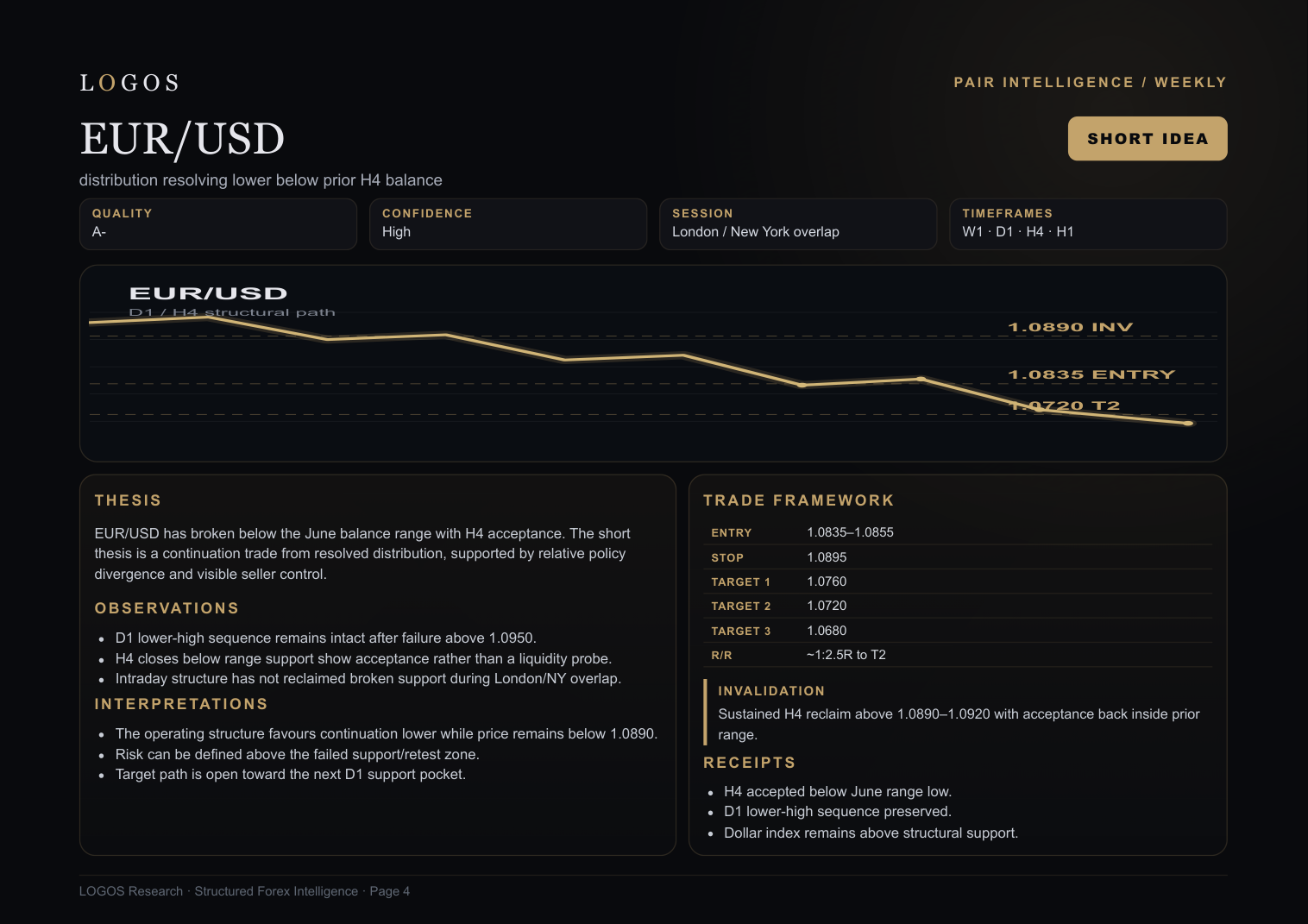
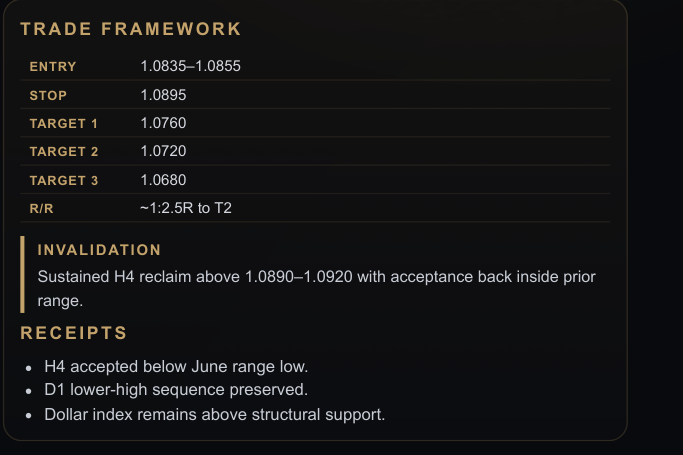
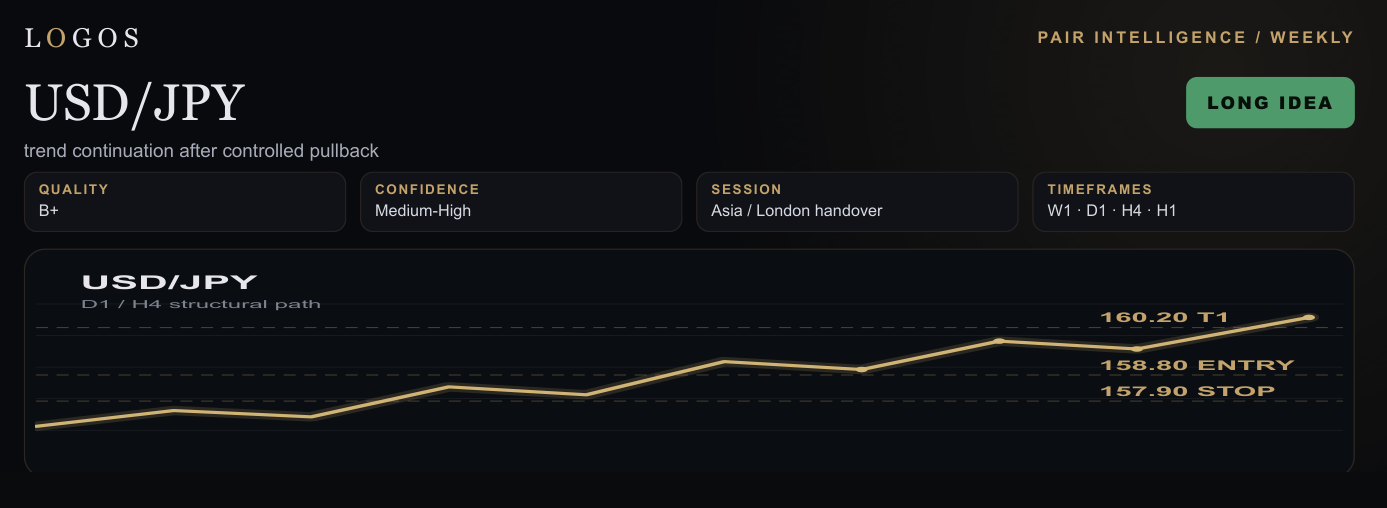
Each LOGOS report is a structured research object, not a market comment. It covers a selected currency pair with a complete analytical chain: market context, directional thesis, entry zone, stop-loss reference, take-profit scenarios, invalidation conditions, and risk/reward framing. Every report is archived and reviewed, so the research improves over time.
Market Context
Macro backdrop, central-bank posture, sentiment conditions, and key technical structure for the selected currency pair.
ContextThesis & Directional View
Reasoned directional bias with supporting evidence, key levels, and the structural argument behind the setup.
ThesisEntry Zone
Defined price area where the thesis is most actionable, with rationale tied to structure, momentum, or sentiment.
EntryStop-Loss Reference
Technical or structural level that would invalidate the entry logic — used as a risk reference, not advice.
RiskTake-Profit Scenarios
One or more objective areas with reasoning, probability framing, and conditions for partial or full exit.
ObjectivesInvalidation & Outcome Review
What would falsify the thesis, plus post-analysis comparing expected vs. actual — closing the learning loop.
ReviewEntry zones, stop-loss references, and take-profit scenarios are research components designed to frame risk and clarify reasoning. They do not constitute financial advice, trading recommendations, or guarantees of any outcome. All trading decisions and risk management remain the responsibility of the individual trader.
See the full weekly briefing structure.
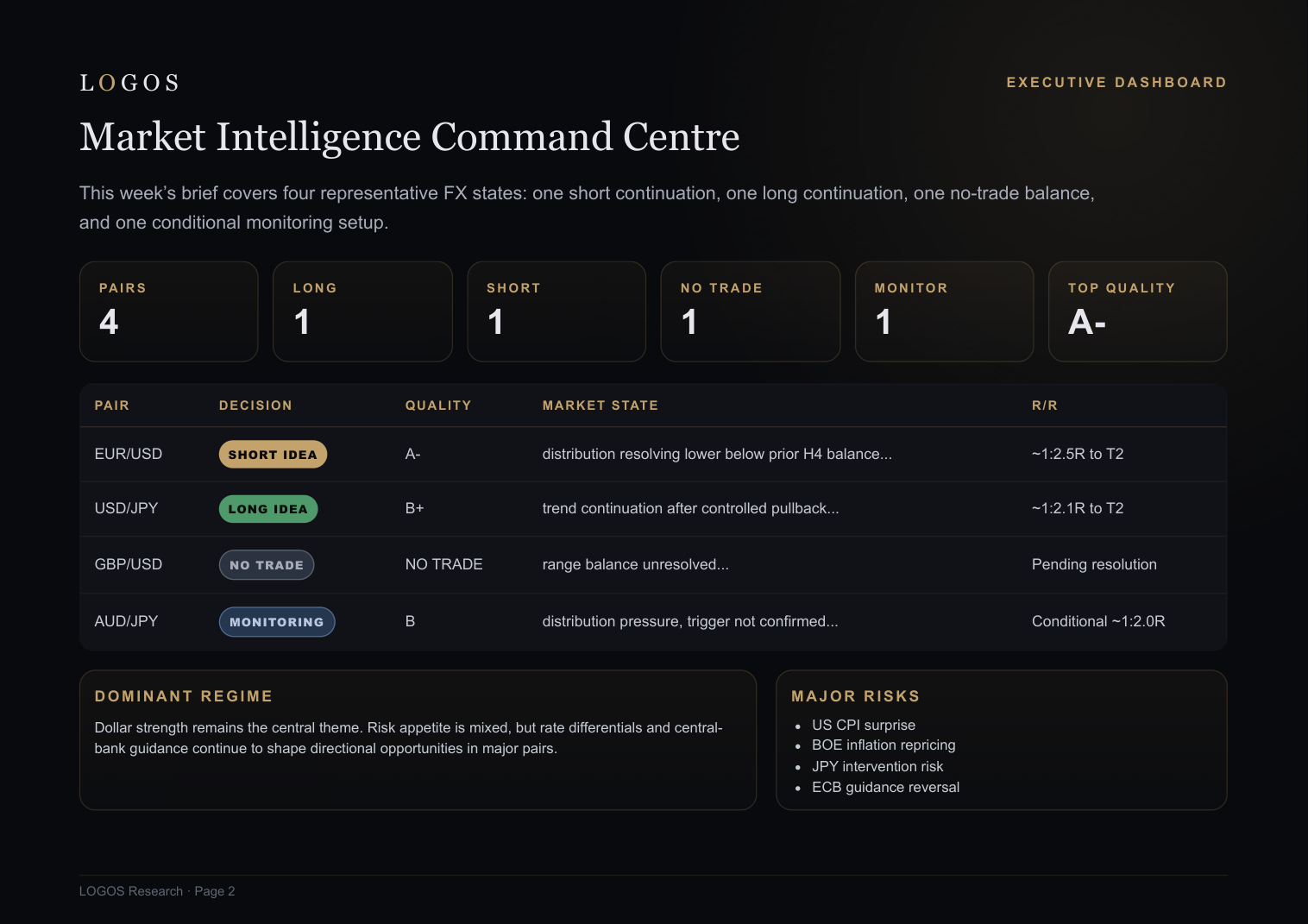
A LOGOS report moves from executive dashboard to macro context, pair-specific analysis, trade framework, charts, and responsible-use notes — structured for review, not hype.

Built first for foreign-exchange
structural research.
The first LOGOS research track focuses on major foreign-exchange markets, where multi-timeframe structure, macro sensitivity, liquidity, and session behaviour create a useful test environment for disciplined market intelligence. Additional markets may be considered only after the research process is stable and reviewable.
Every analysis preserved.
Every outcome reviewed.
The research archive is not an afterthought — it is the backbone of the LOGOS system. Every thesis, decision, scenario map, and outcome review is stored in a structured, searchable format. The archive makes it possible to:
- ◆ Review past theses against actual outcomes
- ◆ Identify patterns in reasoning across multiple analyses
- ◆ Track the evolution of market understanding over time
- ◆ Audit the complete decision chain for any given period
- ◆ Distinguish between skill and luck in research performance